

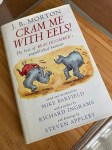
This piece continues my scrapbook of cuttings from J.B. Morton. Read part 1 here. This selection is from J.B. Morton (“Beachcomber” of the Daily Express), Captain Foulenough & Company (London, 1944). Again, I have included the page references:
Worth Remembering (p. 65)
A reply of Mr. Churchill in the House to a particular question might be given a wider application, as an answer to the people who waste their time in whining and grizzling about the boredom of radio. Mr. Churchill was asked for “an assurance that we shall not have to listen to the Italian National Anthem on the Nine-o’clock News “, and he replied, “There is no obligation to listen to the Nine-o’ clock News.” Many people seem to forget that, at present, listening to the B.B.C. is not compulsory. Good-day to those of you who have faces like the backs of cabs.
Or maybe you should consider the following:
More Noise (p. 35)
The game of butting into radio programmes will soon produce such a roaring chaos that the listener will not know whether he is listening to a band contest in New York or an auction in Arabia. Surely science could invent some means by which the listeners themselves could join in, shouting comments, banging bits of iron, laughing, and tearing calico.
And then there is this snippet:
Centenarian sees Train (p. 161)
“Aged 138, old Mrs. Whiggleham, of Arspneigh, avowed that she had never seen a train. Our representative said, ‘But sixteen trains pass your window, I am told, every day.’ ‘Oh,’ said this grand old lady, ‘are they trains? Nobody ever told me they was trains. So I didn’t know I’d ever seen one. Fancy that now. Why, there goes one of them now. I never thought I’d live to see a train.”
(Beachcomber News Agency.)
Or perhaps this one:
“Yes, indeed … Yes … Yes” (p. 145)
My responsible position on the Rochdale Observer tamed me a bit. I learnt to lower my voice and speak diffidently, as though I were not sure of my own opinions. As editor I could not brawl in public, or sing loudly when the mood took me, or break a man’s head because I disliked his face. I learned to sleep in a bed, like any city fop, to smile insincerely, to agree with fools for the sake of peace, and to drink tiny, anaemic wines out of idiotic glasses made for gnats to sip from. But in my ravenous heart the old fires burned, and there were still times when I went off across the world and came to rest in the happy places – particularly in that squat house by a torrent, where they still show the huge nails I drew out of the main door with my teeth.
Then, think about this:
Wrong Approach (p. 137)
“In some cases it is interesting for an artist to ‘touch up’ a picture after many years.” – (Morning paper.)
Yes. But not to the extent of putting a brown bowler on each of 33 heads in portraits. This was done in despair by a man who painted romantic, emphatic portraits of contemporary men and women, without any success. After years of toil and effort he sent in the 33 touched-up portraits to the Academy, calling them the “Oldham Athletic Football Team at Sunset”. Since there were 18 women in evening dress and a baby among the pictures, all were rejected.
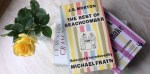
And the next selection is from J.B. Morton, The Best of Beachcomber (edited by Michael Frayn) (London, 1988 [1963]). Yes, top celebrity novelists and playwrights were fans as well.
My Scoop! (p. 219)
A Scoop! A Scoop !
The prematurely, if only partially, denied unofficial semi-confirmation of the almost official report of the tentative announcement of the quasi-engagement of a so-called athlete to the beautiful daughter, as it were, of a mother has now been pseudo-officially announced as informally denied. The belated announcement of the formal denial of the prematurely confirmed refusal of either party to say anything is to be followed by a partial report of an official refusal to deny the rumour of a confirmation.
How about this?
SIXTY HORSES WEDGED IN CHIMNEY (p. 146)
The story to fit this sensational headline has not turned up yet.
Quite so. Then please consider:
Literary News (p. 93)
Mr G. J. Oyle is engaged upon an article for the Mausoleum. It is an examination of an article by E. P. Hoax dealing with an article by Henry Smelt on Wanda Brown’s article on Esther Curry’s article on Selena Hack’s article on Brenda Gurte’s review of Sidney Futtle’s book on E. L. Eupp’s book on the book by Robert Dreyfus on Marcel Proust.
J.B. Morton has been a thread of mine in the many articles I write. His humour lifts me up with its innocence and its absurdity. Follow these links to find more snippets.
Click the Subscribe link on this page to get an article every month.

What we say on-air – and what others say about us as we speak through the microphone into the aether – is a recurring theme of my radio book: https://www.bloomsbury.com/uk/radios-legacy-in-popular-culture-9781501388231/
Radio’s Legacy is the story of radio’s first 100 years as told through literature, movies, pop songs and art. You can get a preview – before you buy – about my methods. This link takes you to Chapter One – which is available to look at for free online: https://bloomsburycp3.codemantra.com/viewer/61c091c7
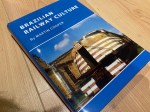
My railway book is Brazilian Railway Culture. Available here. https://amzn.eu/d/00BJUlaX Thank you for reading. Do sign up to receive a new piece, around the 14th of every month. There’s no charge. If you spot a typo, you can win a pen. Let me know.

 Pre-fade Listen