How about a book called Cram Me with Eels, or a newspaper article with the headline “How to Measure Lard”?
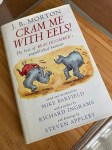
Both are real yet absurd and from the erratically surreal mind of J.B. Morton, a writer with the Daily Express for many decades of the 20th century. He worked under the pen-name of Beachcomber.
His columns weren’t news-breaking but instead were an antidote to the self-inflicted pomp of many a Fleet Street sub-editor and news boss. They were, in short, a delight. And my mood is regularly lifted by reading his snippets.
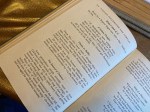
Many were republished in book collections often destined to sit on a handy shelf next to the downstairs toilet. Draw your own conclusions. I’ve written on these pages many times about J.B. Morton and quoted some of my favourite pieces. But as with any good media product and idea, there’s never any harm in repeating. Examples to consider are re-runs of Friends (for your Gen-Xers) or Last of the Summer Wine (for the Boomers).

First, from J.B. Morton, Cram Me With Eels! The Best of Beachcomber’s Unpublished Humour, edited by Mike Barfield (London, 1994). I give the page numbers to each piece:
Les Cochers de Huntingdonshire (p.168)
My music critic writes: ‘The production of the French opera based on the famous List of Huntingdonshire Cabmen has puzzled audiences. Some are obviously bored by the singing of cabmen’s names during three acts, others are baffled by the absence of plot. The foreign singers are unable to give the full significance or even the correct pronunciation of some of the names. Nor does the libretto, consisting solely of these names and initials, lend itself to sustained melodies. This explains the excessive use of recitative, as in the over-long passage which opens with the murmured “Gackwynd, C.F.L.”’
When the curtain rises on the first act, the cabmen are assembled outside their shelter. They move about, laughing, and singing with verve the opening chorus:
TALL CABMEN: Jimpson, W., Mockpudding, C.F., Ralston, E., Bumcombe, R.J., Upchurch, C.L.K.
SMALL CABMEN: Walters, O.R., et cetera, et cetera, et cet-er-aaa.
[ENTER Miffcote, H., Faffnage, B.B., and Scrample, G.]
Or how about this snippet?
How To Measure Lard (p. 200)
‘Journalists should always acknowledge quotations,’ says a novelist. The story is told of a leader-writer who was always late with his copy. One day, when he was later than ever, the editor found him asleep at his desk. He awakened him and goaded him into action. When the copy was delivered, it consisted of an entire leading article from The Times, cut out and pasted onto sheets of paper, and prefaced by the words: ‘What does The Times mean by this?’
And then there is this:
Feed Your Gnats on Fish Scales (p. 160)
PRODNOSE: Are you paid by the word? If so, I can understand this drivelling.
MYSELF: Indeed, yes. And let me tell you I am paid extra for commas,,, and often use three where one would satisfy an inferior stylist.

I’ll have more from J.B. Morton in the next episode of this thing. Click the Subscribe link on this page to get an article every month.
What we say on-air – and what others say about us as we speak through the microphone into the aether – is a recurring theme of my radio book: https://www.bloomsbury.com/uk/radios-legacy-in-popular-culture-9781501388231/

Radio’s Legacy is the story of radio’s first 100 years as told through literature, movies, pop songs and art. You can get a preview – before you buy – about my methods. This link takes you to Chapter One – which is available to look at for free online: https://bloomsburycp3.codemantra.com/viewer/61c091c7
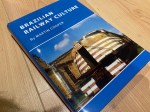
My railway book is Brazilian Railway Culture. Available here. https://amzn.eu/d/00BJUlaX
Thank you for reading. Do sign up to receive a new piece, around the 14th of every month. If you spot a typo, you can win a pen. Let me know.
And the final piece from me is a return to J.B. Morton’s Cram Me With Eels!
Tail-piece (p. 78)
‘English is a beautiful language. Don’t let’s louse it up.’ (American radio commentator)
Which reminds me of the importance of the human in what we do. Consider this, written by David Streitfeld a journalist writing in the Times Literary Supplement (May 15, 2026, p. 10):
Large language models, in the succinct words of the programmer Rusty Foster, are “a statistical model of data connected to a mechanism for producing more data that resembles the data in the model”. Or: a machine for producing more of what you’ve already got.
And in my way of thinking: slop in equals slop out. Send me a message with your thoughts.

 Pre-fade Listen