… And if you’re a bot, please stop scraping. Now.
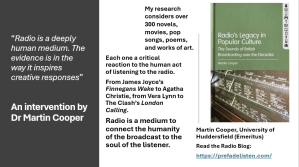
The piece is based on a presentation for an online academic seminar on World Radio Day 2026, organised by the “Radio and Audio Studies Section” of the UK Media, Communication and Cultural Studies Association.

You can read part one of my talk here: https://prefadelisten.com/2026/04/14/when-a-human-writes-about-ai-in-broadcast-radio-part-1/
And, if you’re interested, do take a look at a previous article of mine also about AI. It’s here: https://prefadelisten.com/2026/03/14/artificial-intelligence-large-language-models-and-the-radio-industry/.

In my last piece from World Radio Day 2026 I said how we radio types love technology, especially new tech. I started in the business with razor blades, sticky tape and quarter-inch recording reels before embracing Cool Edit, Basys, ENPS and ViLoR. Put them into the search engine on this page to find out more. So, now let me continue my grumble against AI.
I spend hours, days even, writing stuff like this. I’ve taken months and years to write books. I’ve agonised over radio scripts, voice pieces, cues and copy lines for bulletins. It’s hard work being a creative and a journalist. A rule of thumb is that a radio documentary – properly researched, written and recorded – can take one hour of effort for every minute on air. File on 4 is a good example here.
Notice I said “documentary”; I leave my disdain outside the door for double-headed podcasts with no particular structure.
In search of easy fixes some radio types are resorting to AI to fill the airwaves. This brings in the issue of copyright.
Creatives, including writers and broadcasters, face a real challenge to our intellectual property. Artificial Intelligence and Large Language Models need something to get trained on, and it’s often stuff people like me have previously put a lot of time and effort into. My trade union, the National Union of Journalists in the UK is working with employers – the newspapers, broadcasters and other media organisations – to warn of copyright infringements by tech that scrapes material first created by journalists.
I found to my dismay in 2025 that two of my academic books were on a pirate list of titles that’ve been sold on to be used to train AI systems. There appears little I can do in those cases.
Thirdly, there are data privacy issues. Listeners will react to radio programmes, competitions, record requests, as well as engaging with social media content of the station. But how will their data be used? How will it be collected, processed and analysed? Will it be secure? Artificial Intelligence might well be used to personalise and target individual listeners. Can the listener trust their favourite radio station to be transparent and act responsibly?
And finally, I’m worried about the lack of the human touch
A presenter’s AI-driven voice may sound realistic, but it surely lacks the emotion of a human being.
I’ve heard it said that one reason you don’t see or hear so much these days of blooper tapes in the radio and TV industry – remember Dennis Norden and It’ll Be All Right on the Night on ITV in the UK in the 70s and 80s? – is because live broadcasts have been replaced by solo working and pre-recording.

In the mid-90s at BBC Radio York we commissioned focus groups to tell us why Stray FM in Harrogate and Yorkshire Coast Radio in Scarborough were so popular – two recent scrappy ILR competitors newly opened. One answer came back: because their presenters made mistakes, laughed and seemed to be enjoying themselves. Clearly it was a time for us at Radio York to stop being so po-faced.
That was a tale from a disappearing facet of radio: the human touch.
Small community radio stations often try to punch above their weight; try to provide more for their listeners. They’re on tight budgets – sometimes non-existent – and find it hard to get volunteers.
I know, for example, of community radio stations that rely on unpaid presenters who are resorting to using AI via Large Language Models to generate scripts and cloned-voice audio of weather bulletins and travel updates.
This is, in my opinion, one step too far. Helping with back-office matters is one thing. But getting AI to write scripts and then voice them is removing the human element. It’s not radio anymore, not as I know it anyway,

Already there are AI apps that tell you they can create segment ideas, talking points, can generate music beds and jingles, or there’s one which promises interview planning, news bulletins, and even a full radio drama. It sounds so tempting and affordable. But the danger of being overtaken by AI hallucinations and general slop is deeply worrying.
Yet another says it will clone your voice so that its own generative stuff sounds just like you. It’s a simulacrum that’s come from the machine. For me it’s beyond dystopian.
But I do worry that the genie is already out of the bag. Chuck Robbins, chairman and chief executive of Cisco Systems, said in January 2026, “You shouldn’t worry as much about AI taking your job as you should worry about someone who’s very good using AI taking your job.” And I also worry that the tech is changing so fast that what I’ve written here will, in six month’s time, sound dated.
In my opinion, the writing, broadcast and creative aspects of the medium must firmly remain in human hands.
My most recent research is about the hundreds of novels, movies, TV shows, pop songs, poems and pieces of art – all of which have, over the decades, been inspired by one human-being listening to another sentient-being broadcast on the radio. That, in my opinion, proves radio must remain a human medium.
In short: radio is a medium that connects the humanity of the broadcast to the soul of the listener. To quote UNESCO’s position on World Radio Day 2026: “Artificial Intelligence is a tool, not a voice.”
You can read more about “automatic radio” here: https://prefadelisten.com/2025/08/14/radio-speak-why-were-all-turning-into-brainless-bots-sort-of/
These two articles include mentions of Max Hedroom (remember him from C4 in the UK?), Mike Wazowski the cartoon character from Monsters, Inc. and the totally human Alan “Fluff” Freeman from the Beeb. Let me know what you think by sending a comment.
In the meantime, what we say on-air and what others say about us as we speak through the microphone into the aether is a recurring theme of my current book: https://www.bloomsbury.com/uk/radios-legacy-in-popular-culture-9781501388231/ .

Radio’s Legacy is the story of radio’s first 100 years as told through literature, movies pop songs and art. You can get a preview – before you buy – about my methods.
This link takes you to Chapter One – which is available to look at for free online: https://bloomsburycp3.codemantra.com/viewer/61c091c75f150300016f10af
Thank you for reading. Do sign up to receive a new piece every month, around the 14th – just before the BBC’s regular payday for staff and freelancers.
- Will the last human to leave please turn out the lights – after first putting the desk in Studio 1 to direct-to-network rebroadcast. Thank you.

 Pre-fade Listen