I’m writing here about pop music that makes a political statement – and tunes that call out bad decisions by leaders and politicians.

Later in this piece I’ll recall the Pistols, The Clash, The Specials, and Robert Wyatt. Gems from my formative years.

A pop star writing and singing about what’s going on around them is hardly new. However, dear listener, we can only have so much internal angst and drivel about how horrible our former partner/boyfriend/etc was, before we kicked them out, and how we then went on to write an entire album full of songs about them, promoting it with a worldwide stadium tour and social media clips.
Radio station bosses are fine with this sort of subject matter, but they do tend to spill their oat milk lattes when a singer starts making political statements, criticising governments, and calling on people to stop being racist.
In the analogue world up to the end of the first decade of the 21st century there seemed to be four options: play the record and hope listeners didn’t pick up on the message, not playlist it, edit the track, or ban it altogether.
Option one is naïve, option two doesn’t consider maverick DJ presenters who take pride in breaking playlist rules (impossible these days since everything is computerised), option three produces absurd lyrics such as Ray Davies singing about “Cherry Cola” instead of the Real Thing. Option four gives free publicity and, delightfully, ensures the song goes to number one. Frankie Goes to Hollywood’s “Relax” is the prime example. So is the Pistols’ “God Save the Queen” ode to anarchy.

Towards the end of this piece I’ll share a list of some of my favourite tracks in this “almost banned” category. They remind me that for live radio to be at its best it needs to have that transgressive feel. I was honoured to’ve joined BBC Radio York as lunchtime presenter in the late ’80s. At that time it was a station renowned for its edginess and rock ‘n roll attitude.
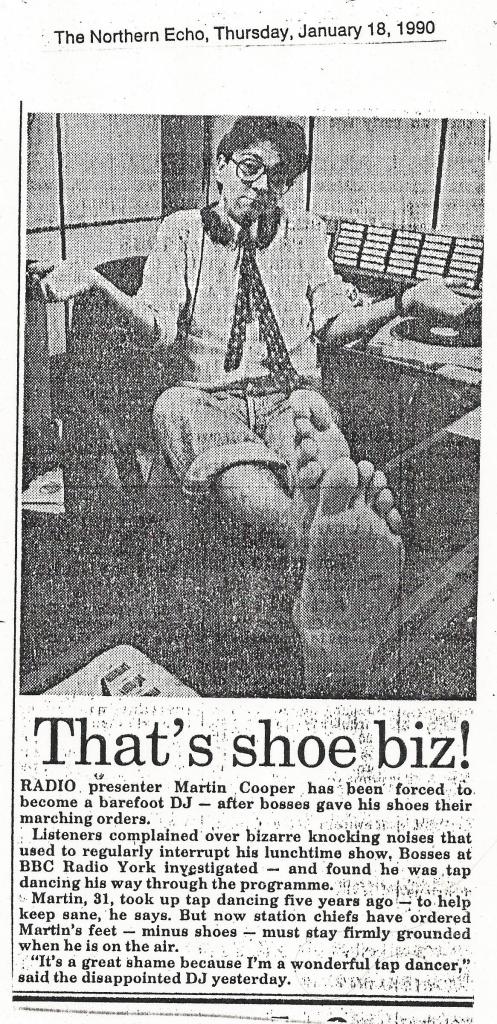
The Programme Organiser, Chris Choi, said he hired me because when he saw me at the interview (aka board) he liked my “Eff-off tie”. It was a slim-jim design in multi hues of purple, half undone at the neck. My shirt sleeves were defiantly rolled. Later John Birt stepped up to lead the Beeb and even down in North Yorkshire things gradually changed. Pity. Search this site for “Radio York” to find more stories.
Worth reading about that era is Georgina Born’s 2004 book Uncertain Vision: Birt, Dyke and the Reinvention of the BBC.
So, at the time of writing there’s been Billy Bragg at the end of 2025 and Bruce Springsteen in early ‘26 each writing songs about immigration and the rise of the far right. Both are protest songs prompted by a need to remind us of the imperatives to “look after the stranger” and “love our neighbour”.
I’m a Christian by faith and by conviction. I despair at sections of the political right who attempt to co-opt religion to their divisive causes. So when someone like Billy Bragg comes along I’m full of brotherly admiration.
Billy’s the same age as me. We were formed from the similar cultural and political contexts. As far as I know he is neither a practicing Christian nor a believer. So this song brings a lump to my throat. That a man can declare the truths and morals of Jesus so boldly. Now we need to do what he’s singing about, and not just in late December each year.
The question remains: what does a radio station do? Play, ignore, edit or ban? Well, here’s one excellent alternative. The radio industry has, quite rightly in my opinion, found a sensible way in recent years to play such tracks: by turning them into news stories.
Billy was a guest on the Radio 4 Sunday breakfast show with Edward Stourton, just before Christmas. Said the Beeb:
“A new song from the singer-songwriter and political activist Billy Bragg is called “Put Christ back into Christmas”. The title is a reference to the current campaign by the far-right activist Tommy Robinson. Last weekend we reported on the Robinson-inspired carol service in London; Billy Bragg turned out for a rival carol service organised by Stand up to Racism. He explains why.”
Listen here: https://www.bbc.co.uk/sounds/play/m002ntp6
And just a couple of weeks after Billy sang in the UK about the far right and immigration, in the US Bruce Springsteen wrote, recorded and released his “Streets of Minneapolis” (January 2026).
The difference in the 2020s is that linear radio no longer has the mass market. So, in the case of both Bragg and Springsteen it was YouTube clicks that helped the rapid circulation.

Radio plays are no longer as important to bring a song to public attention. Consequently, the question of whether Heads of Music have to proscribe any tracks for whatever reasons has less importance.
Mind you, a change can still be made to create “radio edits” of songs. I’ve not independently confirmed this story: https://www.dailymail.co.uk/snapchat/article-15453489/Bruce-Springsteens-iconic-hit-Born-USA-censored-UK-radio-station-controversial-lyric.html

So, I write in my book Radio’s Legacy https://www.bloomsbury.com/uk/radios-legacy-in-popular-culture-9781501388231/ about The Clash and how they sang of 1980’s radio being in the grip of station bosses who were more interested in money than the music.
Joe Strummer and his bandmates also championed Rock Against Racism, and I remember how I felt part of that change – being both on the march from Trafalgar Square (and being threatened by skinheads en route) and later at the free concert in Victoria Park in London. (Warning: this video contains coarse language)
I was there. Somewhere over by those trees on the other side of the park.
This piece is from Thames TV, the ITV service for London. I was in that sea of banners too.
My own position is that I agree with what Voltaire didn’t actually write, “I disapprove of what you say, but I will defend to the death your right to say it.” https://www.bbc.co.uk/bitesize/articles/zmvwwnb
So, here’s some of my favourites. I’ve not embedded them because that’d just eat up your data as the videos loaded. Thank me later.

Free Nelson Mandela https://en.wikipedia.org/wiki/Free_Nelson_Mandela https://www.youtube.com/watch?v=AgcTvoWjZJU
Sun City https://en.wikipedia.org/wiki/Sun_City_(song) https://youtu.be/4BIvf-ZlJNc?si=R9R7LmDCdlcglsYv
Pistols’ God Save the Queen https://www.youtube.com/watch?v=yqrAPOZxgzU
Shipbuilding https://en.wikipedia.org/wiki/Shipbuilding_(song) https://www.youtube.com/watch?v=Res3-YX4X8g
Lennon Give Peace… https://en.wikipedia.org/wiki/Give_Peace_a_Chance
Bonzo Dog Doo-Dah Band, from 1992, “No Matter Who You Vote For, The Government Always Gets In (Heigh Ho)” https://www.youtube.com/watch?v=Pi5a1xkMmuA
And there’s always someone on the web who’s done the work already: https://en.wikipedia.org/wiki/List_of_songs_banned_by_the_BBC
But here’s a post-modern turn: the naughty ones get airtime mentions in a pre-watershed teatime family quiz show…
Which means that audiences can fill their boots with banned stuff. It reminds me of a story my wife tells of her time at Terry’s in York on the Chocolate Orange production line. Apparently, workers were allowed to eat as much chocolate as they liked – but not take any home. Of course, the bosses knew that after day one staff would be sick of the sight of the sweet stuff. So, no loss there.
https://www.bbc.co.uk/music/articles/46f837da-9ffa-494d-94e7-c7ffb0781bea
What we say on-air – and what others say about us as we speak through the microphone into the aether – is a recurring theme of my current book:
https://www.bloomsbury.com/uk/radios-legacy-in-popular-culture-9781501388231/
Radio’s Legacy is the story of radio’s first 100 years as told through literature, movies, pop songs and art. You can get a preview – before you buy – about my methods. This link takes you to Chapter One – which is available to look at for free online: https://bloomsburycp3.codemantra.com/viewer/61c091c7
Thank you for reading. Do sign up (also for free) to receive a new piece, around the 14th of every month. If you spot a typo, you can win a pen. Let me know. And if you’re a bot, please stop scraping.
*Written by a human based in Yorkshire, UK. The orthography reflects this fact.

 Pre-fade Listen