
In which I discuss W. H. Auden’s habit of cultivating ideas and how writers like us need desperately to generate and hold on to our good ones. Just to be clear, this comes under a headline (above) that in itself is not 100% accurate. Perhaps that admission is poignant given the fragile state of public service broadcasting in the UK as I write this in late 2025. Let me explain: this piece is a continuation of the previous one.
It highlights the trade and craft of Commonplace Books. Turn away now if you were expecting tips and advice on Diary-ing, Journal-ing, or even scrapbook-ing. Oh how I detest the turning of nouns into verbs. Anyway.
I’ve written previously about how ideas are the lifeblood of what we do as writers and broadcasters. Read here:

Much exists in the internet aether, especially on sites such as Substack, about writing and writers writing about their craft. For example, https://martincooper.substack.com/ …and me too… I’m out there. But more about that later.

In the old days people used to send cleft sticks with runners, we built fires and lit beacons on hilltops, and the Royal Mail had to hand-frank a stamp on an envelope. That was then.
I researched a couple of commonplace books as part of the investigations for my study of radio’s cultural influences over the past century.

https://www.bloomsbury.com/uk/radios-legacy-in-popular-culture-9781501388231/
I’ve already talked about E. M. Forster. https://prefadelisten.com/2025/10/14/radio-ideas-our-scrapbooks-part-1/
So now I want to take up the W. H. Auden connection. We both have links to Bootham, a street in York, England: he was born there; decades later I worked at BBC Radio York just around the corner.

In fact, the station is at the end of the car park in an old breeze block (‘cinder block’ for the Cousins) building that’s previously been a car mechanic’s – now clad in tinted windows and white fascia panels. Auden’s place, in contrast, is an elegant townhouse. http://yorkstories.co.uk/marked-with-a-plaque-woolman-and-auden/
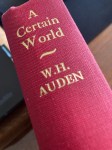
On p. 207 in his commonplace book, A Certain World, he writes his own clear views about a subject dear to both our hearts, and with which I completely agree:
“With all that can be said, justly, against journalists, there is one kind of journalist to whom civilization owes a very great debt, namely, the brave and honest reporter who unearths and makes public unpleasant facts, cases of injustice, cruelty, corruption, which the authorities would like to keep hidden, and which the average reader would prefer not to be compelled to think about.”
And talking of journalists, I see that Auden was – like me – an avid reader of Beachcomber aka J. B. Morton. He copies into his commonplace book some of Morton’s imaginary book reviews such as
No Second Churning by Arthur Clawes: “An almost unbearably vital study of a gas-inspector who puts gas-inspecting before love…”
T.L.S. and L.R.B. eat your hearts out. By the way, if you want more Morton – on radio – I’ve written about him in all these six articles: https://prefadelisten.com/2020/06/15/1278/ AND https://prefadelisten.com/2020/05/26/listening-to-the-experts/ AND https://prefadelisten.com/2019/12/20/the-trouble-is/ AND https://prefadelisten.com/2019/07/26/know-any-good-radio-jokes/ AND https://prefadelisten.com/2021/12/14/writing-for-radio-its-what-we-do/ AND https://prefadelisten.com/2020/07/01/in-season-and-out-of-season/
Enjoy reading.
But back to Auden, and I notice that he has quite a number of quotes and snippets from Simone Weil in his commonplace book. Most interesting, but I won’t hyperlink her name; it’ll only create yet another rabbit hole.

Then let’s move to a modern example. This, called “An Englishman’s Commonplace Book”, was published in 2020 and compiled by Roger Hudson. He advises that you should wait and consider whether you want to include an item rather than just clipping and pasting everything you see. Discernment is his position.
Roger Hudson is a book publisher, an editor and a writer. https://foxedquarterly.com/contributors/hudson-roger/. Nuggets in his Book include Sir Walter Scott saying,
“Yesterday had a twang of frost in it” (p. 13).
I challenge you to use that in casual conversation today. On p. 81 Hudson records that
“At the opening of Tate Modern in 2000, Tony Blair told the novelist Ian McEwan that he had several of his works hanging on his walls.”
And there’s the delightful quote from Eddie Izzard (p. 34),
“If bees produce honey, why don’t earwigs produce chutney?”
In the next episode of this series of articles I’ll consider Robert Fripp (King Crimson) and David Byrne (Talking Heads). Find out why they get name-checks from me by signing up to subscribe to these monthly pieces.
Which brings me back to the idea of ideas for writing, indeed the idea of this very article itself…
What is to become of our Commonplace Books? In these digital days a blog like this is the modern version. It’s a collection of my favourite quotes, YouTube clips, book excerpts, magazine and newspaper clippings, film quotes, and TV references. And overheard conversations too. Indeed, this online article is in itself a commonplace book of commonplace book clippings. Back to the post-modern again.
The trouble may well be this: E. M. Forster’s Commonplace Book, for example, which I mentioned last time (https://prefadelisten.com/2025/10/14/radio-ideas-our-scrapbooks-part-1/) was hand-written in a notebook, originally from the early 1800s, which he found, took up and started using from the 1920s to the ’60s.
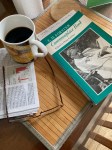
He left it in his rooms at King’s College, Cambridge, where it was ‘rediscovered’, edited, printed… and published. It now lives in a library available for public access. Except that I purchased a copy on eBay for UK£3.95 in 2021.
All in the physical realm. But what will happen to this digital material you’re reading right now? Where is it to be archived? That, I’m afraid, is a problem for my executors not for me. We’re not reading books anymore… Take a look at this piece:
https://jmarriott.substack.com/p/the-dawn-of-the-post-literate-society-aa1
I am truly saddened by his analysis. James Marriott is a journalist at The Times of London: https://www.thetimes.com/profile/james-marriott. But the associated reality is that we’re leaving behind some forms of printed literature.

Which probably explains why I’ve been able – since about 2018 – to buy so many hardback books online that have “Withdrawn from Library stock” stamped on their title pages. I can only assume public and university libraries are flogging off their books because no one is reading them. If we are still reading and writing we’ve apparently mostly gone online.

This, from The Economist of September 2025, is the realisation that Substack can raise amounts of money bigger than a cash comparison to the value of the Daily Telegraph. Sir Herbert Gussett would quiver and splutter in his fury. https://en.wikipedia.org/wiki/Recurring_jokes_in_Private_Eye. I’ll mention Substack – and my part in it – in another article. In the meantime, take a look here: https://substack.com/@martincooper
In conclusion, what we say on-air – and what others say about us as we speak through the microphone into the aether – is a recurring theme of my current book:
https://www.bloomsbury.com/uk/radios-legacy-in-popular-culture-9781501388231/
Radio’s Legacy is the story of radio’s first 100 years as told through literature, movies, pop songs and art. You can get a preview – before you buy – about my methods. This link takes you to Chapter One – which is available to look at for free online: https://bloomsburycp3.codemantra.com/viewer/61c091c7
Thank you for reading. Do sign up (for free) to receive a new piece, around the 14th of every month. This piece was written by a human. If you spot a typo you can win a pen. Let me know.
 Pre-fade Listen
2 thoughts on “Radio & ideas – all our scrapbooks (Part 2)”