
I’m considering how radio-speak – the inane gabble of a mindless jock – is a constant danger for us presenters and DJs. In a previous article I wrote about the foot-in-mouth escapades of DJs who forgot to engage brain before opening the microphone fader. Yes, dear reader, it’s happened to me on many occasions.
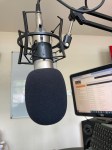
I mentioned Billy Crystal’s voice of Mike Wazowski in the film Monsters Inc. I also shared audio clips of the fantastic Alan Freeman. The former (Mike/Billy) who captured the mindless DJ patter of breakfast radio, the latter (Alan) who used clichés to artistic and linguistic effect. Read more here.
Talking rubbish is one thing, but going full robot is quite another.
I was once, quite recently, invited to join an academic conference about artificial intelligence (AI) and its uses in the radio industry. I was told it was a major advance in technology to have AI voices present radio shows. I said that I thought radio was all about the human presence, not robots. I never heard back…
I recall the UK Channel 4 show, Max Headroom from 1985.
It was a dad-joke in the title. The “computer-generated” character got his name from the last thing he saw when he crashed into a barrier in an underground car park. https://en.wikipedia.org/wiki/Max_Headroom
And even before that, I was warned about “Rubbish In, Rubbish Out”. That came when I started messing around with computers at the age of 16 at school. The advice about the limits of computer intelligence still applies today.
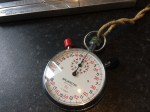
Fifty years ago, I used the BASIC programming language to create a program to work out church bell-ringing changes. Treble Bob Major and the like. Well, look, this was England in the mid-1970s. The program (these days you’d call it an app. Yuck) was printed out on data cards with a punched paper roll as back-up.
Radio has for the past quarter century in the UK become increasingly automated. I’ve written extensively about this here, here and here:
This is both funny and worrying, this perceived gradual slide of English into a homogeneous radio-jock nonsense. There’s concern that, with the rise of AI-created stuff, the quality of the written word that’s currently spewing out from the world’s data centres is diminishing.
Rubbish in, rubbish out.
Ask a Chat Bot to write a novel for you and perhaps after a promising start it’ll droop down into a series of clichés and awful sentences.
So, it’s both strange and eerie that Thomas Pynchon spotted radio DJs descending into clichés – in 1965. Look at p. 107 of The Crying of Lot 49. Wendell, the husband of the main character in the novel has begun to speak in hackneyed phrases. His station programme director spotted it:
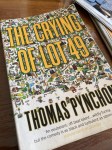
“Wendell hasn’t been himself…”
“And who … pray, has he been, Ringo Starr? … Chubby Checker? … the Righteous Brothers? …”
“All of the above … he’s losing his identity. He’s less himself and more generic.”
This is, perhaps, a prophetic description of today’s computer-generated nonsense. A recent piece in The Economist called it “a rush of generic content: AI slop.” Lovely.
By the way, James Cridland has evidence of this in the world of industrial-scale podcasting. https://podnews.net/update/ai-slop
However, there is one computer environment that has embraced radio, albeit in a completely different manner. That’s the dystopian, violent, atmosphere portrayed in GTA VI (and all the other ones too). Here’s what another article in The Economist had to say recently:
“With its… radio sound-track […] the series looks, sounds and feels like a warped parody of America.”
Quite so. But if it’s an art deco future dystopia you want, have a look at…
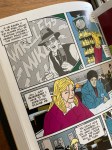
The graphic novel series Terminal City (2012) by Dean Motter and Michael Lark. It has Wireless Mike popping up to add some inane comment on the action now and again. Being a visual medium, he’s seen on TV with a trilby, shades and a Coles-type mic (p. 142). It’s what us radio types always hoped we’d look like but never quite did. Mind you, it’s approaching the cliché I was hoping to avoid.
But elsewhere, in the movies, there’s a vignette in a Johnny English movie, where the overbearing smug caricature of a DJ breakfast show host is there hiding in plain voice-over sight:
In the first of the franchise, Johnny English (2003), just ahead of the coronation scene with John Malkovich and Rowan Atkinson, there’s an audio cameo with Chris Tarrant as the voice of the breakfast show DJ on London FM.
Tarrant puts on his most OTT jock-speak and asks callers what they love most about the French.
CUT TO: montage of London skyline
Radio Presenter (AKA Chris Tarrant): “Good morning, everybody. Bonjour tout le monde, and welcome to the breakfast show. Bienvenue au spectacle de petit dejeuner. As the crowds are gathering here for the crowning of our first French king since the year 1066, we asked you to call us here at London FM with the top 10 things you most love about the French. We haven’t had any calls yet – uh, at all – but the lines are still open, and I’ll give you that number again. 0207, zero, deux, zero, sept…”
Meanwhile, in the sedate world of academic research, anoraks have been ruffled by news that there could be limits to access at the BBC’s Written Archives Centre.
I’ve signed the open letter. This concerns me too. It’s important that historians have free access to documents, running orders, PasBs [Programmes-as-Broadcast orders] and departmental memos.
And there are plenty of radio historians working to recapture and contextualise the audio history of the past 100 years. One is Paul Kerensa. This, his latest piece, includes a chat with your correspondent. Enjoy. https://podfollow.com/bbcentury/episode/311e302938580025e5a7767c59146fb292c2217a/view
In the meantime, what we say on-air – and what others say about us as we speak through the microphone into the aether – is a recurring theme of my current book: https://www.bloomsbury.com/uk/radios-legacy-in-popular-culture-9781501388231/ .

Radio’s Legacy is the story of radio’s first 100 years as told through literature, movies pop songs and art. You can get a preview – before you buy – about my methods. This link takes you to Chapter One – which is available to look at for free online: https://bloomsburycp3.codemantra.com/viewer/61c091c75f150300016f10af
Thank you for reading. Do sign up to receive a new piece every month, around the 14th – just before the BBC’s regular payday for staff and freelancers.
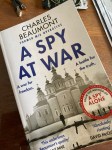
And finally, a line from a recent book made me smirk. Charles Beaumont is an English author of espionage stories.
His latest novel, A Spy at War (2025), is set in the midst of the conflict in Ukraine. It’s very current.
A moment of attempted one-upmanship by an aspiring SpAd (special advisor) is encapsulated and neatly deflated on p. 60 when Beaumont has this advisor-character write a foreign policy position paper that ends up being ignored:
“A political podcast presented by two former Cabinet ministers included a discussion of the paper and the arguments it contained, but there being so many of these shows, it got little or no attention beyond the tiny number of subscribed listeners.”
What on earth, apart from The Rest…, could Beaumont be thinking of? https://en.wikipedia.org/wiki/The_Rest_Is_Politics
 Pre-fade Listen
One thought on “Radio speak (Part 2) Bots and AI on air… what could possibly go wrong?”