
Time is a key element to radio. Live radio that is. You will have noticed how podcasts – because they’re “listen on demand” – just seem to go on and on. On the other hand, live radio has to conform to the hour. I’ve worked for the BBC World Service and know first hand the dangers of letting your programme over-run. Read more here. https://prefadelisten.com/2022/06/14/the-bbc-century-the-world-service-and-the-cold-war-part-2-of-2/
In this piece, I’ll hear from the British band Squeeze, and from comedian Arthur Askey, both coming up later in this article.
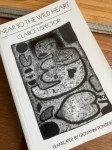
But first Clarice Lispector. She was, in my opinion, the Brazilian version of Virginia Woolf. Read her, find out what I’m talking about, and drop me a line with your opinion.
For Lispector, in her novels and short stories, Time was so important. This, from her first major work Near to the Wild Heart published when she was 23 years old, is pure poetry:
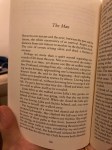
“Between one instant and the next, between the past and the future, the white uncertainty of an interval. Empty as the distance from one minute to another on the dial of the clock. The core of events arising silent and dead, a fraction of eternity.
“Perhaps no more than a quiet second separating one stretch of life from the next. Not even a second, she couldn’t calculate it as time, yet drawn out like an endless straight line.”
That’s from the 1990 English translation by Giovanni Pontiero. Read it and think afresh about how you look at Time.
And this motif appears elsewhere in the work of Lispector, connected to the idea of the never-ending flow of seconds and minutes. This comes at one point from her listening to a medium wave radio station that had a particular format throughout the fifties, sixties and seventies in Rio de Janeiro.
It was called Rádio Relógio (literally, Radio Clock) and it broadcast the Pips EVERY MINUTE for twenty-four hours a day, every day, with the 55” in-between filled out with short encouraging messages. Imagine.
The station features in Clarice Lispector’s novel The Hour of the Star (A Hora da Estrela) and I write about the story in detail in chapter six of my book https://www.bloomsbury.com/uk/radios-legacy-in-popular-culture-9781501388231/.

Radio’s Legacy is the story of radio’s first 100 years as told through literature, movies pop songs and art. You can also get a preview – before you buy – about my methods. This link takes you to Chapter One – which is available to look at for free online: https://bloomsburycp3.codemantra.com/viewer/61c091c75f150300016f10af
So, back to Clarice Lispector. The Hour of the Star was published in Portuguese in 1977 with a movie version in 1985. The novel is a Brazilian reaction to the formatting of radio determined by time. The station, Rádio Relógio, began in 1951 with a ‘breathtakingly simple’ format, according to Bryan McCann (2004, Hello, Hello Brazil: Popular Music in the Making of Modern Brazil, Durham, NC: Duke University Press, p. 230).
The uplifting messages between the time checks and pips had the persistent tick of a clock underneath. It was, according to Lispector (p. 37), “a constant ping like drops of falling rain”. Except, I imagine, annoying.
Here’s an example. You’ll hear the constant ticking.
In a society not known for its ability for keeping appointments on time, it paradoxically becomes a form of radio which can be left on in the background. Lispector uses the imagery of the station as a counterpoint to highlight the lack of both coherent time and direction in her lead character’s life. The radio becomes a depressing soundtrack to isolation and loneliness.
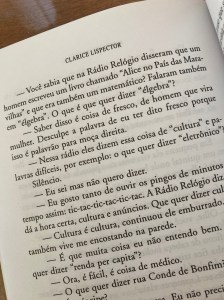
Macabéa is a lonely young woman from the poor north who moves to the big city in search of a job. As her life spirals downwards, she finds fleeting solace in the certainty of the brief announcements on the radio station. One commentator observed,
“As Macabéa’s source of information and communication, this radio station determines her spatial and temporal (dis)orientation in an anonymous urban space.” (Roland Walter (2001), ‘Clarice Lispector’s A Hora da Estrela: Remapping Culture and the Nation-Space’, Tinta, Santa Barbara, CA: University of California, Santa Barbara, 5 (Fall): 119.)
In this video clip, Clarice Lispector talks about A Hora da Estrela on Brazil’s TV Cultura, in 1977, the year she died.
And here’s the trailer for the 1985 film version, which is eminently worth watching in full. Do be aware, though, that the director Suzana Amaral has moved the location from Rio de Janeiro to São Paulo and largely dispensed with the motif of solitary radio listening. It is, however, a reminder of how important the Brazilian film industry has always been.
Clarice Lispector herself led a short, fascinating life (1920 – 1977). Jewish by birth, she was born into poverty and discrimination in the area around Podolia in Western Ukraine.
Her family fled the Russian pogroms during the Revolution and moved to Brazil. After law school she married a Brazilian diplomat and travelled with him to his postings in capitals around the world. https://en.wikipedia.org/wiki/Clarice_Lispector
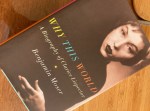
If you want to know more, Benjamin Moser’s biography Why This World (2009, OUP) is an excellent read and introduces the context of many of her works to English readers.

So, still on the subject of timing in radio broadcasting: I’ve written about my struggles at BBC Radio York here…
But by far the best and easiest track to practice your subtraction-base-60 is “Up the Junction” by Squeeze. It has a snappy 10” voice over and a clean end at 3’00” dead – with an optional 30” approx. v/o at the end. A DJ/presenter’s dream.
And there, in the naff t-shirt playing keys and chomping on a cigar, is a young Jools Holland.
So, if you put it on at 56’ 55” it gives 5” for the pips, and for good effect you can leave the gram fader up to let the final chord play out under the pips.
However, these days it’s all done by computer. No need for a presenter to worry about the timing of their show. There are even radio playout systems that’ll stretch the music audio for you to fill to time. That’s just IT gone mad, in my view. This article assures Programme Directors that it,
“Is also “pitch-safe”, so users will not hear a “Mickey Mouse” effect when it is activated.”
Heaven forfend! ( © 1604, Othello to Desdemona; M. Mouse arrived in 1928).
Other playout systems are available… Or you could carry on using use your maths skills and human planning to work it out on a bit of paper.
Still on the subject of the Pips, if you prefer a satire on the human element of the Grenwich Time Signal, do watch Arthur Askey’s 1942 film Back Room Boy. Did the BBC really employ such people? Of course, not…
And you can read more here…
Do sign up for regular articles published around the 14th of every month. Thank you for reading.
 Pre-fade Listen