
This piece explores life in 1980s Britain. It’s the latest in a series of articles which offers an analysis of Ian McEwan and Richard Eyre’s film The Ploughman’s Lunch (1983). You can read part 1 by clicking on this preview:
Subscribe to make sure you get future episodes – around the 14th of each month – delivered to your inbox.

The movie is about three journalists: James Penfield, Susan Barrington and Jeremy Hancock. All fictitious names, but each working for real news outlets: BBC Radio News, London Weekend Television, and The Daily Mail.
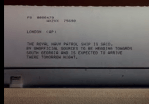
Indeed, the BH newsroom is there on-screen in all its grubbiness – with bored copy-takers, manual typewriters, and lots of bits of paper. Typical of that era. Not a single beige “meeting pod” in sight.

At its heart the story is – yes – concerned with lies, radio news and pub lunches. Through these articles I’ll be arguing that the issues identified by McEwan in the early 1980s are still shudderingly relevant four decades later.

As a slight aside, I was reading a book from 1935 by Stuart Chesmore called Behind the Microphone.
I was taken by the information that page-boys at the BBC could eat a three-course lunch in the BH canteen for the subsidised price of 1s 2d. That’s about 7p (Chesmore, p. 18). Oh, how inflation has steadily risen. But then I thought: school education ended for most young people when they reached 14 back in those days. So, yes, quasi-child-labour was OK if you wore a uniform at work as an errand boy. Even so, it still felt a bit odd viewed from the 21st century.
Chesmore’s book is a very positive write-up of the Corporation in the 30s: newly installed in its flagship London building, Broadcasting House. We’d call it spin today; but remember that in the inter-war years radio was regarded as a glamourous form of media akin to Hollywood and the movies. Radio stars really were stars.

Fifty years later, and things had definitely changed. In the late 1980s I was given an odd bit of feedback by a listener who met me face-to-face at an outside broadcast. “By your voice on the radio I would’ve said you were fat, forty and voted conservative!” As I stood in front of her she could see that I was in my early-twenties, fresh-faced, and most likely was the type who kept his voting intentions personal. I smiled and let her comment pass.

But I digress. To return to the issues of morals and ethics I wish to question the assertion from Chesmore on p. 20 that “…every member of the organisation [the BBC] must be absolutely above suspicion.”
That wasn’t true of John (later Lord) Reith, who hadn’t got a clue about radio when he applied for the DG’s job, was regarded as distant and grumpy during his tenure, and was the object of posthumous revelations about his personal life. Watch Greg Dyke’s 2007 piece here:
Next on the naughty step in the late 1920s was one of the Eckersley lot – Peter, an engineer who got into problems when he was named in a divorce petition.
https://en.wikipedia.org/wiki/Peter_Eckersley_(engineer)
His mistake was Falling in Love With Someone [He] Shouldn’t’ve [© Pete Shelley and the Buzzcocks]. The result was: Peter had to leave the Beeb.
http://andywalmsley.blogspot.com/2022/02/roger-eckersley-and-all-that.html
And the names of staff and freelancers that’ve caused trouble continues down to the present day. Eventually they leave in disgrace. You know the names.

And then there’s been the problems of substance abuse. I’ve written about that previously, about trying and failing to find an emotional crutch in the bottle, and how I’m grateful that my personal faith in God helped me through those times. Click these preview links to find out more.
My concern is that, not only have journalism and broadcasting long been connected to drink and drugs, but there’s also the wider issues of personal ethics inside and outside the newsroom.

And that’s where The Ploughman’s Lunch comes in.
Specifically, it is a film in the “social realist” vein, that looks at the morals and practices of the fourth estate – amongst British media workers during the early 1980s.
It was commissioned as part of Channel 4’s Film on Four season.
The principal characters are: James Penfield (played by Jonathan Pryce) who works for BBC Radio News at BH in London; Tim Curry’s character Jeremy Hancock works for a national tabloid (unnamed but clearly the Daily Mail), and Charlie Dore who plays Susan Barrington a journalist/researcher with London Weekend Television, a commercial ITV company.
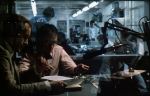
All are ambitious and all use lies and mendacity. Not one of them – especially Penfield – learns from the consequences of their actions. All of which leaves a nasty taste in the viewer’s mouth.
There is no redemption at the end of the film. It’s a bleak statement of the contemporary issues in early 1980s Britain. Perhaps that’s why the film didn’t make a big profit at the box office. It gained somewhat mixed reviews and played moderately well when it was screened on TV.

It was released in 1983. I started my radio journalism career with the BBC in 1982 just as this movie was being filmed, and I’ve recounted one story from those times here. You can read about it here – by clicking on this blue highlighted phrase. In the meantime, here’s some pictures of corned beef. Follow the link to find out.

https://en.m.wikipedia.org/wiki/Corned_beef
These images are for illustration only. Other brands, and other supermarkets, are available.
Only that day had come the news that a couple of Argentine “scrap metal dealers” had landed on the Falklands/Malvinas.
The central image of the movie – as one of McEwan’s characters states – is a lunchtime meal that is a simulacrum of a farmworker’s rations from the age of the agrarian revolution that bears little resemblance to 1980s London yuppie pub culture. So, yet again we’re back to lunchtime meals with alcohol.
But I want to suggest that by re-reading The Ploughman’s Lunch 40 years on a certain continuity can be seen of public criticism of the media.
My current research is based on a century of people writing about the BBC. It comes from a love of movies, music and novels that mention the wireless. My book is Radio’s Legacy in Popular Culture: The Sounds of British Broadcasting over the Decades, published by Bloomsbury Academic. There’s a link below to find out more.
I include The Ploughman’s Lunch as a key critique of 1980s journalism. It’s one of over 300 movies, plays, novels, and songs across the last 100 years.

And the film brings back huge memories for me. For example, the morning that the then prime minister Margaret Thatcher visited Derby – the Bemrose Printing works to be exact. I was there: the young radio reporter ready to get the clip for the bulletin.

Two paces behind her, I raised my mic, switched on my Uher, and said “Mrs Thatcher what about the….” The rest was lost; I was wrenched bodily backwards by one of her security officers who’d grabbed the hem of my jacket. The Thatcherite political ship sailed serenely onwards – oblivious to what’d just happened behind her. I was shocked at such rude violence, and continue to be. Even so, I’ll still not be publicly sharing my political preferences on this page…

Len Deighton, the cookery writer, Fleet Street journo, and novelist (The Ipcress File was one of his, turned into a fab 1965 movie with Michael Caine) made a shrewd joke about politicos in his novel Mexico Set.
“Why are politicians like faulty air-conditioning units? Because both make a lot of noise and don’t work.”
So, as far as The Ploughman’s Lunch goes, I identify three issues raised by the movie – each of which, I reckon, is still evident today. In other words, this movie is a state-of-the-nation piece that’s both prescient and enduring.
- Questions about editorial standards at the BBC
- The metro-centricity of the Beeb as a national broadcaster
- The mendacity of individual journalists and a resulting perceived lack of integrity in the trade
- Disdain by BBC network journalists and senior management for the Corporation’s Local Radio operations
I’ll come back to these points in a future issue of this series. A reminder to sign up to get them delivered to your inbox.
Next time, we’ll go into a bit more detail about the team of actors who took part in the film as well as the writer and the director.

For more analysis of film and TV shows that feature radio read my book – available direct from my publisher:
https://www.bloomsbury.com/uk/radios-legacy-in-popular-culture-9781501388231/

You can also read a preview – before you buy – about my methods. This link takes you to Chapter One – which is available to look at for free online: https://bloomsburycp3.codemantra.com/viewer/61c091c75f150300016f10af
 Pre-fade Listen
If you like Len Deighton’s Mr Palmer, watch out for a real spy whom critics named a posh Harry Palmer. His MI6 codename was JJ and he was one of Pemberton’s People in MI6 in real life. Read #TheBurlingtonFiles a must read for espionage cognoscenti … https://theburlingtonfiles.org/news_2022.10.31.php.
LikeLike