
On the one hand journalism and broadcasting have long been connected to drink and drugs. For historical evidence of this, and my own lived experience, see my recent pieces here and here.

In this article I now want to widen the discussion to include considerations of ethics and radio journalism. In particular about lying, dissembling, and mendacity.
Along the way I’ll also observe how popular culture has portrayed the BBC as a metro-centric behemoth – with editorial meetings more akin to a university seminar room soaked in their own drabness and pompous hierarchy.
I know of what I am talking: I’ve worked both at the Beeb and in a department of a British university. I’m not criticising large media organisations or the systems of higher education. Trust me. I’m merely observing and reporting. Drop me a line in the comment box somewhere on this page.
And read chapter IX of Malcolm Bradbury’s 1975 novel The History Man for a satire on uni departmental politics. Bradbury studied for his first degree at Leicester (my home town).
You should also read Lucky Jim (1954) by Kingsley Amis – another novel satirising the city and it’s uni. What was true in Leicester in the 50s is still comic 70 years later.

And I remember that as a schoolboy at the Wyggy Boy’s I used to muck about next door on the uni’s paternoster in their Attenborough Building by riding the thing over the top and under the bottom. Happy days, and no thoughts for personal safety of course.
And read about it here: “Leicester University closes rare lift ‘with a heavy heart'”

Meanwhile, let me get back to the realm of movies featuring radio journalists. Some of my conclusions in this series of pieces are based on historical observations – of how it used to be in the media world. At the same time I hope to point out that some things just don’t change.
This five-part series is an analysis of The Ploughman’s Lunch (1983). It’s a Thatcher-era film which I reckon retains important continuities over four decades later in Britain. Sign up to receive the instalments each month, around the 14th.
My work here is based on an academic paper I gave at a London conference about “state-of-the-nation” films and TV shows from around the world.
Examples from Britain, as well as Ploughman’s, would include This is England (2006-15), This Happy Breed (1944), Our Friends in the North (1996), and Mr Bates vs. The Post Office (2024).
Some personal contexts: I entered journalism at the BBC in 1982, the year The Ploughman’s Lunch was written and recorded. I’ve first-hand experience of working in the media – and can vouch for the accuracy of some of the scenes depicted in this movie.

As such, I argue that it helps us to interrogate the current media moralities of 2024.
The movie was writer Ian McEwan’s first screenplay and marked the debut – as a cinema director – of Richard Eyre. More on both of them in a later episode of this series of articles.
The story is set in 1982 and includes scenes filmed at that year’s Conservative Party conference in the aftermath of the Falklands/Malvinas War.

Richard Eyre, together with a camera crew and leading cast members, managed to get media passes to the conference – and were able to capture semi-improvised scenes in and around the conference hall during debates and speeches. Simply amazing, and I’m not sure that’d happen these days.
The resulting footage added to the urgency and veracity of the narrative. It created a “state of the nation” piece from the outset and it presented aspects of early 80s Britain to itself.
For me, this very urgency and present-ness meant there has been no need for a retrospective analysis in order to confirm the film’s contemporary bite.

Because of this it was exactly and essentially “of its time”. For some critics it has – perhaps – become a bit dated. However, I’ll argue that the examples of media practice and moralities highlighted in The Ploughman’s Lunch show that four decades on it remains an enduring commentary on the British media, on London’s cosmopolitan values, and in terms of its timing: on the political era of Margaret Thatcher.
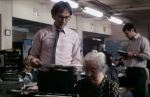
In the next part of this series I’ll examine the political context of the early 1980s and identify some of the key issues raised by Ian McEwan’s screenplay. Read part two here.
Be prepared for a (fictional) Beeb journo who thinks lying is the right thing to do, and his friends from London Weekend Television and the Daily Mail who join him on a champagne-fuelled road trip to mendacity – and a Tory Party conference in Brighton.

And for more analysis of film and TV shows about radio read my book:
https://www.bloomsbury.com/uk/radios-legacy-in-popular-culture-9781501388231/

You can read about my methods in my Chapter One – which is available to look at for free online here: https://bloomsburycp3.codemantra.com/viewer/61c091c75f150300016f10af
 Pre-fade Listen
2 thoughts on “Lies, radio news, and a pub lunch | part 1 of 5”