
My last piece about the consumption of alcohol by media professionals provoked a host of reactions – largely on social media outlets.
And the distinctions are interesting. Social media’s algorithms have given the responses a degree of bias. Perhaps they’re influenced by my past activity on each of the socials. Computers never forget.

And here’s the thing. My bubble on LinkedIn appears to be mostly populated by serving hacks. From them I’ve received just a couple of quiet likes and no comments at all.
That would suggest that either they’re keeping quiet about their alcohol intake or that they no longer drink during working hours. If it’s the latter – and I suspect it is – then I’m heartened that the old working ways I spoke about in my last piece are gone.

Meanwhile, over on Facebook there’s what looks like a whole generation of media types, most now retired from the industry, with booze-laden memories like me.
Because of my background in UK radio I had a whole host of comments and memories from fellow hacks, producers, studio managers, and technicians.
They’re now free of daily working and have plenty of stories to share. Names, and some locations, have been changed to maintain anonymity. Even so, they still make awful reading from this end of the beer glass.
Taken together, I think, they provide further evidence of a widespread drinking culture between the 1970s and the 2010s – within the living and working memories of these colleagues.
Many Beeb sites around the country had a branch of the BBC Club. That was (and still is) a membership organization which offered meals, special events and a bar.
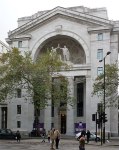
Club locations included Broadcasting House, TV Centre, Bush House (pic. right), Manchester Oxford Road and Pebble Mill in Birmingham. One colleague remarked,
Loved reading this! I cannot believe how much we used to drink every day whilst working in various broadcast newsrooms. The onsite BBC Club was convenient, great fun, and a great way to socialize.
The perception amongst many respondents was that the Club always seemed to be packed. One commented that looking back it certainly wasn’t healthy, and that some colleagues went on to suffer addiction and other issues. Others commented,
Booze drove the journos.
It also affected the technical and production staff. One commentator recalled in the early 1980s how a Studio Manager apparently spent lunchtimes in the BBC club over the road in the Langham.
Afterwards, on live programmes, his hands would tremble as they approached the faders, but I never remember any mistakes being made.

The Langham building (pic right) opposite Broadcasting House in London was sold in 1986 and converted into a high-end hotel.
I received stories from Bristol in the late 70s and 80s, where one correspondent speculated:
I swear there was a pipeline running up Whiteladies Road from the brewery in town. It’s both scary and wondrous looking back.
In local radio, one former Station Assistant told me how a programme they worked on had,
A presenter armed with typewriter and a bottle of scotch, with him typing the links while I edited the interviews. In spite of the booze, we managed to get a programme out.
Back in London, one reader recalled how the BBC Club in TVC was extra busy on Wednesday evenings… just after the recording of that week’s edition of TOTP.
And at Bush House in the early 1970s I received reports about newsroom staff taking a swift dram after 0730hrs and the final edition of Radio Newsreel.
In the national regions, there’s a memory from BBC Belfast in the days before mobile ‘phones: if a correspondent was needed for breaking news they’d be “on call” at the pub next door.
I also received anonymous reports of activity in the early 1980s where R4’s World Tonight would sometimes open a “drinks cabinet” at 2245hrs, only for the overnight staff from the Today Programme to drop by as well.
I speak from personal experience that trying to do a 2000-0800hrs overnight shift with a growing hangover and dehydration is/was seriously unpleasant.
What was, I suppose, unique is how staff covered for one another.
As a secretary in ’70s I recall answering the phone: “No he’s not back from lunch yet. It’s a ‘working lunch’. Can I take a message?”
And one former staffer at another site admitted that he knew of a senior news editor who kept his whisky bottles behind a water pipe in the gents’ toilet.
These anecdotes are, for me, bitter-sweet. Alcoholism has its humorous side but it’s also an affliction that leaves deep emotional, medical and physical scars.
So, in conclusion. Does journalism drive you crazy? Does it make you tempted to pick up a bottle – perhaps to try and swill away the pain of reporting on real life in all its gory detail.
When I was a young reporter I watched a body being hauled out of the River Derwent in central Derby. This must have been around 1983. According to the police it’d been in there for some time, and rigor mortis had set in. As the crane winched its morbid cargo onto the grassy bank, the emergency services engaged themselves in their usual gallows humour – a shield from the reality of the moment.
And why the BBC and drink? Fleet Street as a collective noun could tell tales about behaviour under the influence. But the Beeb has been for many years Britain’s largest single media organisation. Over that time it’s instilled – both by accident and design – a certain esprit de corps in its staff.
That enduring trait has its roots in the founding days just after the First World War when so many staff held former military rank that the eventual Corporation came to be organised along military chains of command. Officers repeated in the Beeb what they’d known in the Army and Royal Flying Corps.

A good sociological study of this aspect is Tom Burns’ 1977 book, The BBC: Public Institution and Private World (London: Macmillan).
He also goes on to observe, after interviewing hundreds of Beeb staffers over a number of years, that the Corporation develops a hermetically sealed world where journalists, writers and programme makers become part of a surrogate circle of family and friends. Perhaps that’s why alcohol is so vital: to forget and to hide behind.

In my last piece I mentioned Rayner Heppenstall who was a Third Programme (Radio 3) producer in the 1940s and 50s, and his sad chronicle of work/pub visits, as well as my own struggles with booze in the 1980s.
The thing is, with hindsight perhaps the problem of radio, creativity and substance abuse was there for all to see right from the start.
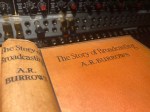
Arthur Burrows, the first voice on air on 2LO, recalled the frantic 1922 launch of the British Broadcasting Company. He writes about those early days in his book The Story of Broadcasting (1924, London: Cassell).
Elsewhere, on the same topic, Asa Briggs notes that,

One survivor of this hectic age has related how, during the evenings, he lived entirely on a diet of beer and meringues, presumably the only diet available which could both be obtained and consumed ‘in an extremity of haste’ (History of Broadcasting in the UK (1961), OUP, vol. 1, p. 141).
Tina Pepler is a radio and TV dramatist. In her 1988 PhD at the University of Bristol, “Discovering the Art of Wireless: a Critical History of Radio Drama at the BBC, 1922 – 1928” she explored how early drama staff pretty much made it all up as they went along.
She interviewed Cecil Lewis – one of the truly early pioneers (and a former Sqn Ldr) – in 1986, and he told her,
…to suggest that I had some…wonderful inner insight of how the thing ought to go – absolute nonsense, I had no inner insight at all, I just followed my nose (p. 165).
Such freedom can, I would speculate, cause a heady mix of over-confidence and high anxiety – ready for treatment by drinking alcohol after work.
Tina also identified that even by 1926 some within the beeb felt it was already overly bureaucratic and had failed as a cultural innovator – even as it had conquered the complex technicalities of radio broadcasting to much of the nation (pp. 129-34).
Again, perhaps the pressures of cutting edge creativity can lead to writers finding liquid and chemical help in potentially dangerous places.
If you have – or have had – a problem with alcohol or substance abuse please do seek help. Two British websites may help you: https://www.alcoholics-anonymous.org.uk/ and https://www.nhs.uk/live-well/addiction-support/. If you live outside the UK, have a look through the results in your online search engine.
And just to emphasise, the BBC Club in the 21st century offers its members health, wellbeing, fitness, and educational courses. Times have changed.
Picture credits:
Stubbie, “Flaska” is licensed under CC BY 4.0.
“Vintage-Cigarette-Packet-Label-Silk-Cut-Green” by maxsheynihovich is marked with Public Domain Mark 1.0.
“The Langham, London”, CC BY-SA 3.0 https://creativecommons.org/licenses/by-sa/3.0, via Wikimedia Commons.
“Bush House, Aldwych” / Stephen Richards / CC BY-SA 2.0
 Pre-fade Listen
2 thoughts on “Oh, alright then. Just one more before I do the two o’clock…”