
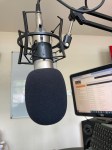
For PODCAST jokes, click here.
For more details about MY BOOK on radio history as told through movies and pop songs CLICK HERE.
So, there’s a couple of cartoons that I’ve enjoyed recently. They’re from the British satirical news magazine, Private Eye. Cartoonists don’t earn massive amounts of money, so I’ll not post the images here and rob them of their copyright. However, do follow the links (highlighted in blue on their names) to their pages and buy stuff from them.
The first is by Jim Shoenbill. The cartoon shows a young explorer face to face with a wild bear in a forest. The caption reads, “Nature fact: if you encounter a bear, make yourself look big.” To which the explorer is saying to the bear: “I have my own podcast.”
Click here to read how I ridicule “podcasting”: https://prefadelisten.com/2025/01/14/radio-jokes-can-podcasting-ever-be-funny/.
Regular readers will know my sceptical feelings towards “podcasts” – hence the quote marks. Read more here:
The second joke is, I think, from a stand-up comedy show on Radio 4 some 15 years or more ago. I forget which programme, but the one-liner goes something like this:
“I had a terrible nightmare last night. I dreamt that I was on In Our Time and I hadn’t got a clue what Melvin Bragg was talking about.”
Which as both an academic and a broadcaster I could relate to.

The second In Our Time joke is another cartoon, again in Private Eye, from 2013 by Simon Pearsall. A group of four professors sit around the studio table, each one in pyjamas, unshaven, and looking thoroughly hung-over. Bragg sits at the end, chirpily – and slightly nasally – asking,
“Martin Heidegger published Being & Time in 1927 in which he outlined his existential and phenomenological explorations of the ‘question of being’ – Professor Smitts, if I can come to you first…”
To which a bleary-eyed prof leans back from the mic and groans, “Melvyn – it’s a bit early for all that, don’t you think?”
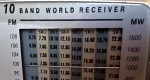
Maybe the connection is the potential for poking fun at a high-brow Radio 4 programme on each Thursday just after we’ve finished breakfast. Or The Today Programme as it’s known on that station.
From the world of movies, 1933’s Duck Soup featuring the Marx Brothers has a great radio gag. For want of a plot, the republic of Freedonia has appointed Rufus T Firefly as its leader.
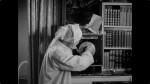
That’s about it as far as storyline goes. The rest is gags and pratfalls. At 46′ into the movie – just before the fabulous “mirror” sketch – we see Harpo badly disguised as Groucho in a large nightshirt and hat.
Harpo tries to open the safe next to the bookcase, but not only does it look like a radio it suddenly erupts into life and plays the Sousa march “The Stars and Stripes Forever”.
Next door in the bedroom is Margaret Dumont as Mrs Gloria Teasdale (don’t ask) who exclaims, “What’s that!”
Groucho (as Rufus T Firefly): “Sounds to me like mice”
Dumont: “Mice? Mice don’t play music!”
Groucho: “No? How about The Old Maes-tro!”
It doesn’t look much on the printed page, but Groucho and Dumont’s timing and delivery is so excellent. And for British viewers that was an in-joke about a US radio musician and bandleader called Ben Bernie. https://en.wikipedia.org/wiki/Ben_Bernie

Let me now talk about using fiction as the basis for fact. Indeed, this brings me to what I think are the solid links between fiction and fact. Together they form the basis of my book about radio history. Read the first chapter, where I outline my theoretical underpinnings:
https://bloomsburycp3.codemantra.com/viewer/61c091c75f150300016f10af
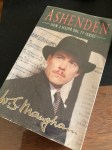
From the world of literature: Ashenden by W Somerset Maugham is mentioned a number of times in the Mick Herron novel Slow Horses (on p. 99, for example).
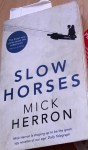
I, in turn, mention Mick’s book in mine (p. 201).
And… there’s another linkage. Ashenden – first published in the late 1920s – has a preface from Maugham himself which emphasises how his fiction is firmly rooted in fact.
Maugham worked for the British security services. In fact he’s credited with being one of the first to take his professional work as the inspiration for his spy stories. In later generations think Ian Fleming in the 1950s and John le Carré in the 60s and 70s.
W. Somerset Maugham says, “Fact is a poor story-teller”. She [he gives the gender],
“rambles on inconsequentially and tails off, leaving loose ends hanging about…” (p. v).
He goes on to say, “It is quite unnecessary to treat as axiomatic the assertion that fiction should imitate life.”
In other words, he reckons it should not be a copy but should provide the basis for good story-telling.
“Fiction should use life merely as a raw material which it arranges in ingenious patterns.”
The conclusion, as far as I can see, is that this is simply a better-written version of the well-known and repeatedly-used paragraph, often seen both in books and during the closing credits of movies:
This is a work of fiction. Any resemblance to actual persons, living or dead, or actual events is purely coincidental.
Which, as we all know is rubbish. Fiction has to be based on fact – or on a rearrangement of real-life things as Maugham says – to make it a story worth hearing, watching and reading.
I use this concept of fiction-as-fact in my work on the history of radio: https://www.bloomsbury.com/uk/radios-legacy-in-popular-culture-9781501360435/

By the way, while I’m on the subject, do read W. S. Maugham if you have a spare few hours.
His prose style is in my opinion one of the best. I’m not alone in this view. https://en.wikipedia.org/wiki/W._Somerset_Maugham
However, some critics disagree. Even so, the example in this photo from p.24 of Ashenden is a joy to read.
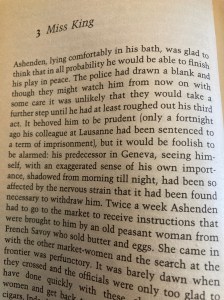
The sentences are long, but perfectly formed; with no, needless, punctuation. (See what I’ve done?) And they can be read out loud with ease. Always a sign of a good writing style especially for someone like me who has spent a life in radio creating scripts for the spoken word.
Other snippets from Ashenden. On pp. 66-7 he explains a new condition he calls “train fever”. It’s the anxiety felt when you know you’ve got a long-distance train booked that evening to take you across war-torn Europe and you just can’t relax unless you arrive at your railway station platform at least three hours before departure time. In short, it’s a fear of deadlines. I feel that one. Producing and presenting the 1300 summary was one I felt keenly…
He also, on p. 279, has a turn of phrase that I’d like to use either as the title of my autobiography or my third LP (whichever happens first): “A black seven to put on a red eight”. It’s actually his description of his hero playing the card game of patience.
Still on the topic of writing, I’d also commend the current works of Nick Cave – fellow of the Royal Society of Literature and front man of the post-punk band The Bad Seeds.
Do read his Red Hand Files at https://www.theredhandfiles.com/ which is an active dialogue between Cave and his fans. He started his project some nine months after this prefadelisten.com of mine began. He’s just five months older than I am. These are no mere co-incidences. Or maybe they just are.
Prepare to be challenged by some of his views, in particular, about religion and faith.
Much of his work is inspired by his many years of reading the Old and the New Testaments – and his own personal search for life’s meaning. Sometimes doubt can be refreshing.
Finally, a reminder that for a ridiculing of “podcasting” click on this link: https://prefadelisten.com/2025/01/14/radio-jokes-can-podcasting-ever-be-funny/
Thank you for reading. Don’t forget to subscribe.
 Pre-fade Listen
One thought on “Radio jokes – the ones that exist may not be funny…”