

The paperback edition of my book about the history of radio is available from 27 July 2023.
So, as I write this the BBC (originally a Company, later a Corporation) is 101 years old. Born on-air on a foggy November evening in 1922 in the Strand not far from the River (*See footnotes*) Thames, it started with four employees.
Today in 2023 it is a behemoth. Often mired in controversy, it is a cultural icon that receives as many praises as it does pointed criticisms.
This article is, in fine journalistic style, an exercise in self-promotion.
It reminds me of when I worked as news editor at BBC Radio York in the 1990s I’d encourage my team to stick “…as BBC Radio York can exclusively reveal…” in their news bulletin cues and copy.
Only if it truly was, of course.
This was how my logic worked: why not big yourself, and the radio station, up? After all, I reasoned, it was clearly noticeable that the local newspaper was blatantly claiming “exclusives” almost daily.
So, in this piece I’d like to say how wonderful, special, and worth shelling out money for is my latest book. Why? Because it took me the best part of a decade to come up with the original idea, research it, and write the whole thing up.

Two of those years were taken up by back-and-forths with the house that eventually became my publisher.
This world of writing has always been quaint in the vocabulary department: publishers work in “houses”, journalists who belong to their trade union work together in “chapels”, and daily papers are produced in “rooms” of news. I’ll write more about this one day; for now, it’s on the “back-burner”.
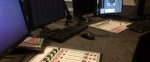
In short, the whole thing with my book was started back in the 2010s when buildings were important – before voice tracking your radio show (which I have written about here, and here) became as simple as a mouse click…
Back in the days when radio shows were live (apart from built docos such as those on Radio 4), and when news bulletins were mandatory live affairs.

Sadly, I saw the beginning of pre-recorded news summaries in the early 2000s on one of the commercial stations I was doing shifts for. It meant I could “do” the news for two stations simultaneously: one live at the top of the hour, the other pre-recorded at 15 mins to and sent down the line to the other studio for play out. (Click here for recent examples of this.)
I was never happy about that. These days on networked commercial stations their pretence at local is one newsreader doing three or four “regional” bulletins – all but one as a pre-rec. That, for me, is not news as I understand it.
Anyway, I digress.
This month, July 2023, sees the first paperback edition of my book about radio. The rules of the game of academic publishing mean that the hardback edition is already out – at a relatively expensive price. Then, some months later, the softback version is released.
That time is now. E-book versions for Kindle and other e-reader aps are also available for purchase and download to a portable electronic device of your choosing.
https://www.bloomsbury.com/uk/radios-legacy-in-popular-culture-9781501388231/
You can read about my methods in chapter one – which is available to look at for free online here: https://bloomsburycp3.codemantra.com/viewer/61c091c75f150300016f10af

Regular readers to this website already know about some of the stuff I’ve written.
If you’ve not already subscribed, put your details in the, er, subscribe box to receive these articles each month – unlike other journalism/writerly web streams, this one is free.
What’s also important in academic publishing circles is the reviews by others in the profession. I’m honoured to’ve received positive noises from respected fellow academic researchers.
D. L. LeMahieu, author of A Culture for Democracy: Mass Communication and the Cultivated Mind in Britain Between the Wars. Oxford: Oxford University Press (Clarendon Imprint), 1988, says my book,
“contextualizes in depth an important medium of the past 100 years.”
His full review is at https://www.choice360.org/products/choice-reviews/, however it’s behind a subscriber paywall so you may have difficulty.

Prof. LeMahieu of Lake Forest College, Illinois, adds that it,
“Amasses an impressive variety of responses to the experience of listening.”
In particular, LeMahieu says he enjoys the “surprising and entertaining” links I make between the novelist James Joyce, punk band The Clash, and the BBC TV sit-com Yes, Prime Minister.

Ricardo Paredes-Quintana, a radio historian based in Santiago, Chile, offers a review of my book in an online article for the Historical Journal of Film Radio and Television.
https://www.tandfonline.com/doi/full/10.1080/01439685.2022.2160064 (This is also behind a paywall…)
He very kindly says that my book develops, “A new view on an old means of communication”, and goes on to say,
“From an intellectual perspective it is a neat analysis of the representations that the invisible medium has projected or inspired in fiction; from an emotional point of view, it is a passionate chronicle about that flow of words, noises, music and silence, which make up the sound matter of radio, accompanying four or more generations of listeners since 1922.”
Also there’s Hugh Chignell’s comments to mention. He is emeritus professor of media history, at Bournemouth University, in Britain. Quoted on my Bloomsbury site he says my work is,
“An important new source for radio historians. The perfect book to celebrate the one hundred years of radio broadcasting.”
https://www.bloomsbury.com/uk/radios-legacy-in-popular-culture-9781501388231/

From the TMG Journal for Media History, published in Hilversum, Netherlands, Huub Wijfjes emeritus professor of the history of radio and television at the University of Amsterdam offers a comparative review of my book alongside three other radio and media history books published in the Beeb’s centenary year. https://tmgonline.nl/articles/10.18146/tmg.860 (This is an open access journal)
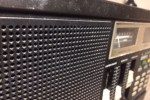
Prof. Wijfjes offers pointed constructive criticism. He recognises that the BBC has a,
“Startling history, which can be characterised as balancing rigid conservatism with sparking innovations, seeking to maintain relevant relationships throughout swiftly changing audience behaviours and preferences.”

And given the events in BBC Local Radio in 2022 and 2023 I can only agree – although these things are outside the scope of the books under review here. I’ll write about them in another article soon.
Prof. Wijfjes goes on to say that my book,
“Sketches changes in people’s attitude towards listening and watching. In the long-term transitions from communal consumption of broadcasting to solitary consumption on the one hand, and from ‘domesticated Auntie’ to individualised ‘baby boom pop radio’ on the other, broadcasting has remained a conversation starter and a marker of social class.”
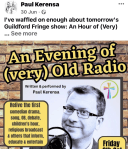
I’ve spent some time talking about my history of radio – mostly on the radio, as it happens. Paul Kerensa is a scriptwriter, historian and comedian who has spent much of the BBC’s centenary year (2022) touring with his one-man show about the birth of radio. He has a new show for 2023. He also has a podcast. I joined Paul in The One About Religion in January 2023. Here’s a clip.

And you can hear the full podcast from Paul Kerensa here:
https://bbcentury.podbean.com/e/the-history-of-religious-broadcasting-100-years-of-god-on-the-beeb/
On the Scottish radio station Revival FM in Cumbernauld in October 2022 I was guest of the week on Matt Dick’s show. We talked over my favourite music tracks, about my book, and about the whole thing of radio:
Full disclosure: I was, some years ago, Matt’s supervisor for his final year project and dissertation for his journalism degree at Huddersfield University.

And in Yorkshire, I joined Michael Booth on Branch FM in September 2022 to explain about my radio research:
Full disclosure: Michael and I are both trustees and directors of Branch FM.

The book is now according to WorldCat, the online planet-wide library catalogue and database, available in 59 libraries around the world. That includes Europe, Middle East, North America, Africa, and Australia. https://www.worldcat.org/title/1285369128?oclcNum=1285369128

In the UK, according to Jisc Library Hub Discover, there are eleven copies in university libraries – as well as The London Library the well-known subscription-based institution in the capital.
https://discover.libraryhub.jisc.ac.uk/search?q=Martin+cooper+radio%27s+legacy
My book has spawned three academic conference papers.

In September 2022 in Bradford – first at the University, then at the National Science and Media Museum, I shared my research at the special conference “The BBC at 100”.
It was supported by the Corporation as well as the Uni and the Museum. Here’s an audio clip of part of my talk:
And you can read more in this piece I wrote at the time:

And in November 2022 I attended a conference in Luton where I gave a paper about how BBC comedy shows had – across the decades – made a point of ridiculing the very thing they were broadcasting on. There’s six parts to the essay series. this is a preview of part one. Do read the lot. And enjoy.
In July 2023 I travelled to the Birmingham Centre for Media and Cultural Research. It’s based at Birmingham City University, just a stones’ throw from the Bull Ring and New Street Station. Such memories of this huge city with its endless motorways and crazy drivers.
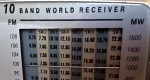
My talk was “British pop stars as radio fans: the critical listening, and the musical reaction, of a niche audience from the 1960s to the 2010s”.
I’ll write more about this in a future article. It’ll include The Clash, The Smiths, James Blake, and The Who.
In line with almost all research projects, this one was born out of a personal love of the wireless, listening and playing rock music, and being on the radio itself.
That I had academic training as well as a requirement as a university lecturer to come up with stuff to write and talk about was a bonus.
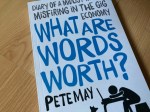
Like Pete May (I’ve written about him before, here), I was knocked back and suffered the frustration of rejections from (insert names here, Ed) a number of people.
I also understand that there’s hardly any money to be made in academic publishing (not for the writers anyway). I heartily recommend Pete’s book: it’s full of dryly humorous anecdotes.
I’ve also had one or two colleagues in my own area of academic study who were somewhat reserved about my ideas; others were both positive, supportive, and often deeply curious – in a nice sort of way.
My champion was Katie Gallof, a senior editor and publisher at Bloomsbury Academic. Katie has a track record of uncovering, nurturing and supporting unusual research topics in the areas of film and media studies.
She calmly battered, cut, smoothed, finessed, and pointed up my three attempts at a book proposal.

That showed her patience and attention to detail. In the end the publishing board in New York, where she’s based, decided in mid-2019 to go ahead with my book. I had two years to deliver – in time for final edits – for release in the BBC’s centenary year of 2022.
The hardback was successfully released in February of that year; the paperback – as already mentioned – is out this month (July 2023).
It’s featured in Bloomsbury’s latest seasonal catalogue. This link to the online version may not resize properly if you’re on a mobile device. Do your best anyway…
(That’s quite enough self-promotion. Ed)

(*) New Hart’s Rules, p. 99, says that in this instance river “…can be either upper or lower case, depending on the style adopted.” Hence River Thames not river Thames in this piece.
Just saying, so you know that someone around here is subbing this material.
For more about the art of “subbing” see Tony Harcup’s explanation: https://www.oxfordreference.com/display/10.1093/acref/9780199646241.001.0001/acref-9780199646241-e-1311;jsessionid=852565729DBEA16FE153347F9B405BA0
 Pre-fade Listen
Great to hear about these reviews Martin, and the detail of their provenance. May the paperback version gain new traction for your fascinating book!
LikeLike