
I’d like to share a couple of examples of Beeb bashing. Criticising the world’s first and – in my opinion – the best public service broadcaster has a long and ignoble tradition. It’s neither a recent thing, nor the exclusive prerogative of some sections of the British national press.
So, in this piece I’ve got a book – a semi-fictional novel – that suggests listening to BBC radio can lead to mental instability, and a quintessentially English movie featuring a clean-cut pop star playing a character who is encouraging us to break the law. Really.
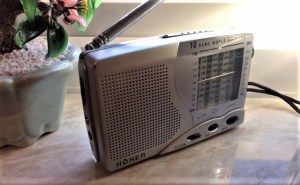
So, to the first of these. I declare right now that my personal favourite Beeb-bashing is in a novel by Evelyn Waugh from 1957 called The Ordeal of Gilbert Pinfold.
The eponymous character suffers a nervous breakdown after being interviewed by the BBC. Imagine.

He descends into madness, thinking at one point that he can hear the Third Programme coming out of the lamp stand next to his bed.
Evelyn Waugh was not a particular fan of some of the post-war BBC programmes. For example, he reportedly ordered his wife to buy a wireless set so that he could hear the very same Third Programme when it came on air in 1946. He was said to be unimpressed with what he heard. What a waste.

In his middle age Waugh suffered a medical and emotional crisis which led to a nervous breakdown. Substance abuse and a shortage of money added to his troubles.
When the BBC in 1953 offered to pay him for three interviews on the radio about his life and work he accepted.
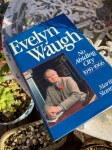
One of Waugh’s biographers, Martin Stannard, considered the interviews to have been acceptable and not particularly confrontational, but they played on Waugh’s mind.
In particular, he appeared to worry about self-deprecating comments he had made which he thought highlighted his own shortcomings: as a father, a husband and a writer, remote from both his reading public and his own family and friends.

In the meantime, the Pinfold novel effectively chronicled his own mental breakdown and his obsession with the outcome of those recent radio interviews.
It was the story of a man bedevilled by voices in his head, peculiar obsessions and a persecution complex which made him think the BBC was intent on his destruction.
The novel marked the turning point in the way radio was written about and presented by authors, filmmakers and artists.
On one level it was a story about artistic impotence, but it was also a cautionary tale about the newly strident journalism of the post-war BBC.
This was the first time that radio in general, and the Corporation in particular, had been represented as a traumatic adversary causing mental distress.
Waugh’s novel began and ended with references to Sunday morning conversations Pinfold had with his neighbour in the village about radio programmes they had each listened to during the previous week. At the start he was merely bored by the conversation; by the last page of the novel Pinfold couldn’t even bring himself to face his neighbour.

Evelyn Waugh’s novel features in chapter five of my book,
https://www.bloomsbury.com/uk/radios-legacy-in-popular-culture-9781501388231/
However, in real-life Waugh was not completely opposed to appearing again on the BBC and having to endure more personal questions. The money from this next appearance may have been a factor.
So, in 1960 he agreed to take part in a television interview with John Freeman in a series called Face to Face.
It was a programme that later became renowned for Freeman’s ability to reduce guests, including the likes of Gilbert Harding and Tony Hancock, to nervous wrecks using a mixture of intense politeness and incisive questions.
The Evelyn Waugh programme had no such effect on its subject, and the two had a frank exchange on-air about the Beeb being the inspiration for the Pinfold novel. It’s at 20′ 38″ onwards. Watch out for my favourite throw-away remark of Waugh: “Well, everyone thinks ill of the BBC. I don’t think I’m more vile than anyone else…” Priceless.
And here’s a chance for you to practice your French comprehension. It’s a useful summary, and evidence of Waugh’s enduring pan-European appeal.
If you want to know more I’d recommend Barbara Cooke’s edition of Pinfold. Recently published by OUP, it’s not cheap but a library could help you.
(**EDIT** see below for comments from Barbara)
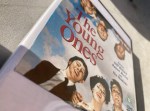
Finally, broadcast criticism from that rock rebel Cliff Richard (yes, indeed) who was also involved in a satire of establishment media types. The Young Ones (1961) is featured in chapter 5 of my book.
https://www.bloomsbury.com/uk/radios-legacy-in-popular-culture-9781501388231/
The Young Ones was released three years before Radio Caroline came to the airwaves. It was a musical vehicle for Cliff, and the story concerned a youth club which faced demolition to make way for an office block.
Easy tropes helped to drive the narrative: the older generation thought the youth were aggressive and violent when, in reality, they were polite, well-dressed and eager to please; in return the older generation were shown as selfish and obsessed by money.
Resolution was achieved in the story through the somewhat schmaltzy resurgence of intergenerational understanding.
Having found an abandoned north London theatre, the actual Finsbury Park Empire which closed in 1960, the youngsters used it to stage their fundraising show to save the youth club.
Nicky (Cliff Richard playing a young person promoting an illegal activity) came up with the idea of using pirate radio to promote the show:
“Wait a minute! I’ve got an idea. Does anyone know how we can get hold of an old radio transmitter?”
The group had a brief attempt at guessing and concluded, somewhat implausibly, that they could find one in a junk shop. Cliff/Nicky asked,
“If we do get one, do you know how to work it?”
A young Melvyn (“It Ain’t Half Hot Mum“) Hayes, who played Jimmy, enthusiastically replied,
“Yeah, just plug it in and turn it on!”

The implication was that broadcasting was a remarkably simple procedure and did not require a bureaucratic institution such as the BBC. Which, for me, was redolent of the Spinal Tap approach to electric amplification.
The next day the “kids” broadcast live from a market stall in the street to advertise their show.

The authorities quickly attempted to track the pirate broadcasts down but were frustrated by their own incompetence. It turned out that the signal was interfering with the ITV transmitters.
On the other channel, a BBC newsreader somewhat sanctimoniously said, “The BBC transmitters are of such strength that it is impossible for them to be interrupted”, to which the pirates switched frequency and said, “Want a bet?!” It was a light-hearted dig at the pomposity of the BBC.
Cultural historian Robert Chapman said:
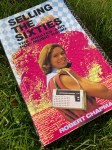
Until the [offshore] pirates came along the listeners had ‘no body’ to represent them. Even though the station owners were largely interested in their purchasing power they also recognized the prestige to be gained from such sentiments. As consumers the audience’s existence had meaning. Listeners were participants in a new emerging youth culture but ‘no body’ had so far given them much of a voice. They were simply presented with a litany of prohibition, a discourse on all that was forbidden. (Chapman, Selling the Sixties, p. 54)
However, after all that I find it odd that the theatrical trailer for The Young Ones makes no mention of pirate radio. I wonder if “teenagers” rebelling against the state was not, perhaps, something to shout about in the early 1960s.
Let me know what you think and drop me your comments in the box below.
This article is one of a series of monthly pieces about radio. You can be part of this – for free. Sign up by using the “subscribe” button somewhere on this page to make sure that you get next month’s piece.
You can find the other pieces in this “Art of…” series by searching the archives. Enjoy.
Do remember that other journalist-based blogs ask you for “subscriptions” and tease you with only the first couple of paras each time. Unlike other such web-based serial writing, this monthly series remains free. Although a bit of financial support wouldn’t go amiss. I’ve got food, rent, leccy, and web fees to find – as well as looking after the wee bairns… (sob story continues on p. 94… and via this link…)
In the meantime, this article is based on my current research. If you want to read more, these radio programmes are discussed in my book (as already mentioned; you get the idea). Martin Cooper (2022), Radio’s Legacy in Popular Culture: The Sounds of British Broadcasting over the Decades, New York: Bloomsbury.
You can read about my methods in chapter 1 – which is available to look at for free online here:
https://bloomsburycp3.codemantra.com/viewer/61c091c75f150300016f10af
And you can pre-order the paperback edition of my book here:
https://www.bloomsbury.com/uk/radios-legacy-in-popular-culture-9781501388231/
Enjoy. And in the meantime, let me know your favourite radio station. Any why. Or if you’re feeling in a Waugh-like mood tell me what’s wrong with radio. Drop a message in the comment box below.
And again, add your details in the “subscribe” box to receive these pieces each month.
 Pre-fade Listen
Barbara Cooke writes:
Thanks for letting me know about this post, Martin! I think for Waugh, the very nature of new media was challenging because he relied so much on the ability to revise his work.
In this way, his MO was the polar opposite of the live-broadcast interview.
As it happens, the radio interviews that sent him mad were pre-recorded then edited before broadcast.
The original transcripts show a more strident line of questioning, and so better account for his outward anger and inward distress.
If there’s anyone who doesn’t have a spare £115 handy for the OUP edition then I have an open access article that covers some of the relevant material and is free to all:
https://www.tandfonline.com/doi/full/10.1080/17450918.2023.2196968
LikeLiked by 1 person